Here are the steps to be trained to be a nest box monitor in Arlington as well as resources for more information. Training has both online and in-person components in the field.
If you are a member of the Arlington Regional Master Naturalist (ARMN) program, all training activities are approved as continuing education. You can log your hours in Better Impact as “VMN Continuing Education.”
1. Contact our Volunteer Coordinator.
Contact us to get assigned to a team. Our nest box trail locations are listed here. Our Volunteer Coordinator can also add you to the Arlington Bluebird listserv and tell you when the next in-person training is. We usually do one every March.
2. Watch the online training.
This 40-minute video is REQUIRED for all nest box monitors in Arlington. You will learn why small cavity-nesting birds need our help, nest building and ID, egg laying and ID, feeding, fledging, and weekly form basics. Led by the VBS County Coordinator for Arlington.
The following video is optional:
For Tips for Nest Box Monitoring, check out this 2023 Training Video — The passcode is 01yzfx*V The presentation is 53 minutes long with some optional Q&A at the end. It focuses on tips to treat predators and pests, protecting chickadees with faceplates, and the importance of native plants. Led by Anne Little.
2. Review training materials.
- NABS Factsheet: Monitoring Bluebird Nest Boxes page 3 and 4 – for nest and egg ID
- NABS Factsheet: Eastern Bluebird Nestling Growth Chart – the best series of photos with descriptions of characteristics for determining the age of bluebird nestlings.
- VBS Weekly Nest Box Monitoring Form can be printed to jot down temporary notes until you have online access to the Google Form to collect data. Your trail lead will have the link to share with you. Please be sure to always record information in the Google Form – not hard-copy.
- VBS Nest Box Monitoring Guide provides instructions for monitoring including how to observe nesting activity, manage problems, and record observations. Reading this guide is approved for up to 30 minutes of continuing education through ARMN.
- VBS Nesting Guides for Each Species – for calculating expected brooding, hatching, and fledging dates.
- A calendar – to help with the above
3. Attend in-person training.
In March, we will have a training where we examine real nests and eggs and learn common issues that arise. Be sure to sign in for credit. This is approved as continuing education for ARMN. If you cannot attend the in-person training, please work with our Volunteer Coordinator to get up to speed.
4. Get started with your trail monitoring team.
Your Trail Lead will:
- teach you how to record your observations.
- work with the team to create a schedule for monitoring boxes from March thru September.
- have a shared bag or bucket with all of the monitoring supplies.
- share a link for reporting your monitoring observations.
On your assigned monitoring day, you can monitor solo or with another member of your team, the entire team, or a friend. Call your Trail Lead if you have any questions in the field.
Trail Leads, here is a copy of We are excited to announce…baby birds! It is a tally sheet of fledglings to share with the general public by posting on a bulletin board in a kiosk or nearby building.
Two endoscopes are available to check out from the County Coordinator. They work on iPhones and iPads using this app and they do not require Wi-Fi.
This project is an ARMN-approved service activity. You can log hours in Better Impact as “Stewardship – Other – VA Bluebird Nest Monitoring.”
Happy monitoring!
Here are some great resources on nest box monitoring:
North American Bluebird Society
- NABS Factsheet: Nestbox Recommendations provides tips on nest box construction, staining, and guards.
- Predator/Problem Identification and Solutions
- Nests and eggs that may show up in bluebird nestboxes – There are links to a “bio” for each species with detailed data.
- NestWatch
- Cavity-nesting Birds Poster
- Educator’s Guide to Nest Boxes has a great visual showing what opening size each species uses.
Nest ID Tips for Purple Martins – Even though purple martin boxes don’t have the same dimensions, this guide provides some good ID tips and information on surrounding habitat for several species.
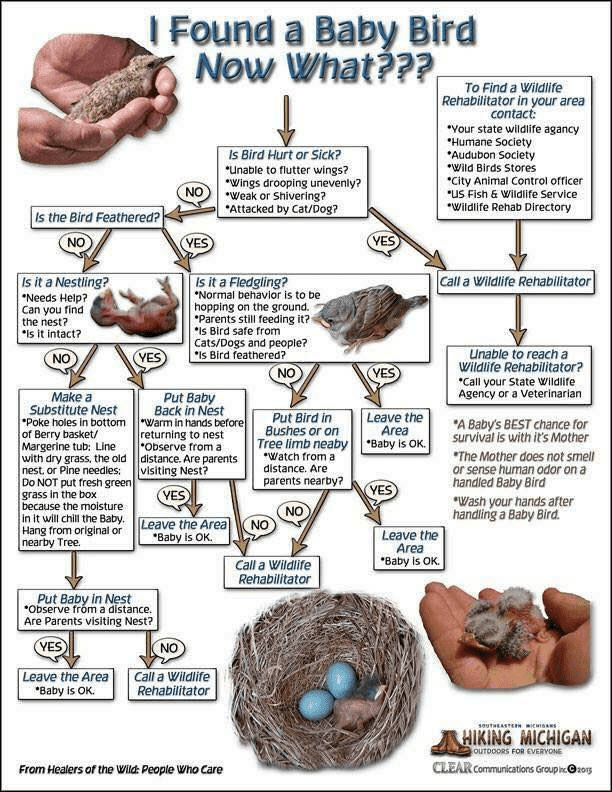
Does this animal need help? https://www.wildliferescueleague.org/animals/does-this-animal-need-help/
 Arlington Bluebirds