Volunteers monitor the nest boxes in a trail (a series of nest boxes) to detect problems early to provide a greater chance of survival. Nest box monitors work in teams to ensure that the nest boxes are monitored weekly during the nesting season of March through September. Our goal is to make more room for native birds to nest and to both deter and remove any nest-building attempts from House Sparrows since they are invasive.
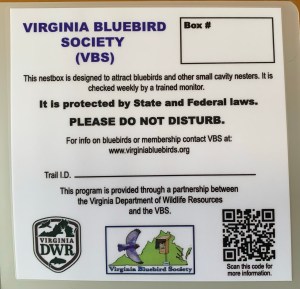
Our nest boxes, poles, and guards are provided by the Virginia Bluebird Society. The predator guards to minimize the chance that cats, house sparrows, snakes, squirrels, raccoons, and raptors will prey on the eggs and nestlings. The Noel guard on the front prevents predators from reaching into the box. The guard on the pole is a snake guard that blocks snakes from getting up the pole. The nest boxes are protected by State and Federal laws.
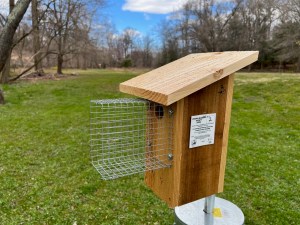
When we monitor, we count eggs, nestlings, and fledglings. We also look for signs of pests such as ants, blowflies, carpenter bees, and paper wasps and use remedies to discourage them from harming the nestlings or boxes.
Anyone can become a nest box monitor on VBS trails, in backyards, or in any place that has nest boxes or cavities for native birds. Training is available online year-round and there is a nest box guide to help prepare for monitoring and troubleshoot any problems. Training is best done in February, so it is fresh for nesting season. At the beginning of the nesting season, the County Coordinator offers in-field training for teams – where monitors see examples of real nests and eggs (old nests and infertile eggs removed from nest boxes after fledging) and learn how to monitor the trail together. Then, the Trail Lead continues monitoring with the team together the first few times until each monitor is ready to monitor independently.
Our experienced monitors lead student groups in monitoring visits on school grounds and teach students and other groups about nesting birds and how to support them. For more information, visit education opportunities.
This project is an approved service opportunity through the Arlington Regional Master Naturalist program.
To get started as a trail monitor, visit Resources for Nest Box Monitors.
(Monitoring photo © Alison Davis-Holland)
 Arlington Bluebirds